Building Lifelong Learners
The Case for A Micro International School
Elemental began with a coffee chat. Two parents, one educator, and a simple question: why isn't there a school that combines Eastern values with Western teaching methods—centrally located and affordable?
We believed other families felt the same way. So we interviewed 20+ bilingual families across Taipei, and two things became clear:
- Almost every parent wants their child to find what they're great at, and find joy, purpose, and prosperity while pursuing mastery in that thing.
- One group stood out as most dissatisfied, even the ones that attended elite international schools. We call them Modern Bilingual Families:
- At least one parent with progressive values, experience living in the West
- At least one parent that’s Taiwan-born with family roots here
- Wanted Chinese fluency without the testing pressure, even though they’re planning for university studies abroad
- Living centrally, needing accessible commutes
- Living in North America, wanting to relocate for language and culture
Our mission became clear: design a genuine alternative to elite international schools for Modern Bilingual Families.
So we recruited more founding families, senior educators, and a community director to work on two things: designing the school and building our founding community.
This vision outlines why we believe that micro might be better than mega when it comes to delivering a genuine alternative designed specifically for Modern Bilingual Families.
What Students Need to Thrive
We studied research on learning, compared top schools and startups, and listened to AI experts. We interviewed more Modern Bilingual Families.
Three discussions emerged:
Academic Mastery vs. 21st Century Skills
For years the formula was fixed: master subjects, ace tests, enter university. Today we ask: do creativity and adaptability matter more?
Two influential books offer opposing views to achieving excellence. Outliers argues for 10,000 hours of disciplined practice. Range counters that broad sampling before specializing builds stronger adaptability.
Range distinguishes between two environments:
- Kind — stable and predictable, where focused practice works
- Wicked — unstable and unpredictable, where adaptability matters more
Yo-Yo Ma practiced cello daily since childhood. But Roger Federer played basketball, soccer, and tennis until age 15.
Demis Hassabis, DeepMind AI founder and Nobel Prize winner argues that since the world is becoming more wicked, "learning how to learn is the most important skill for the next generation”.
Many scholars believe we can apply the concept of range to how students learn. Instead of one method, students experience many: classroom instruction, independent work, hands-on making, collaboration, and using AI as a thinking partner.
Learning how to learn matters as much as any subject. Students build adaptability by practicing many ways of learning.
Teacher-Led Learning vs. Self-Directed Learning
Should teachers lead learning or should students direct it themselves? Taiwan has a rich tradition of scholarship, we believe teacher-led instruction is essential for Math, English, Science, and Chinese. That being said, could extended subjects—humanities, arts, STEM, PE— provide an opportunity to practice self-directed learning?
Recent research reveals the key to student motivation in the modern age: agency—the capability to direct their own learning and follow through.
Jenny Anderson's 2025 study The Disengaged Teen shows that when students feel controlled or disconnected from purpose, they disengage. Not because they don't care, but because they don't see how it connects to their vision of themselves. As Anderson writes, "the opposite of disengagement isn't discipline—it's agency."
She writes that "Agency emerges when students experience meaningful autonomy within scaffolded frameworks—when they make real choices, receive support to execute those choices well, and learn from both successes and failures."
We call students with strong agency 4D Learners—students who can diagnose where they are, design a plan, do the learning independently, and debug when something isn't working.
Core subjects need expert instruction. Extended subjects are opportunities to focus on self directed learning to exercise agency.
Bilingual Fluency vs. English Immersion
Most elite international schools run 90% English, 10% Chinese. Students prepare well for university abroad but struggle to express complex ideas in Mandarin or connect deeply with Chinese culture.
Lee Kuan Yew, Singapore's founding Prime Minister, reflected late in life on the country's language policies. Despite English's success in education and economics, he regretted the cultural depth lost when students don't master their mother tongue. Language isn't just communication—it carries culture, values, and belonging.
Research confirms belonging is foundational for identity, psychological safety, resilience, and persistence.
Historian Yuval Harari emphasizes that thriving in an uncertain world requires "mental flexibility and great reserves of emotional balance."
His key insight: You cannot feel at home with the unknown unless you first feel at home somewhere.
International schools are infamous for creating "third culture kids"—students caught between cultures without deep roots in either. Some Modern Bilingual Families, many who experienced a similar phenomenon growing up in North America, fear the same could happen to their children.
Language is inseparable from identity, and bilingualism is inseparable from the sense of belonging that makes the trait of adaptability possible.
Elemental’s Unique Approach
These three discussions revealed that Modern Bilingual Families have two top priorities:
Lifelong Learning Skills—range across learning methods plus agency to direct that learning
Identity & Belonging—genuine bilingualism, cultural grounding, and community bonds
Most schools in Taipei make you choose between them.
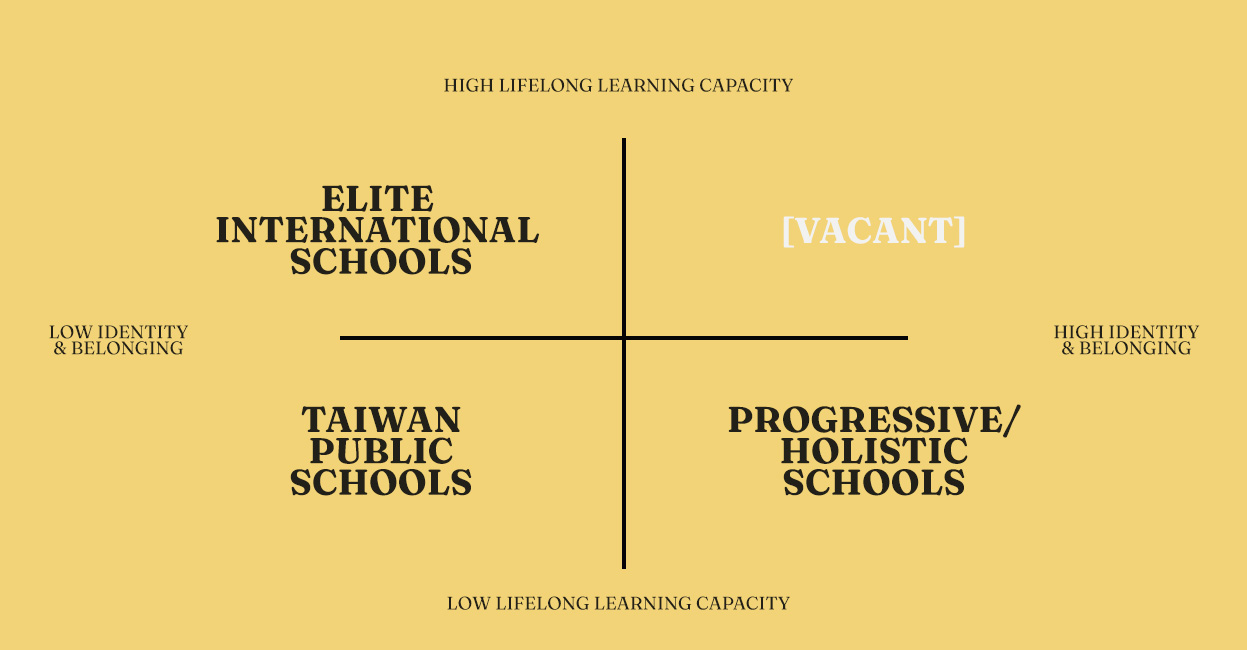
Taiwan Public Schools deliver strong academics and Mandarin literacy but with large classes, single learning methods, and limited international pathways.
Progressive/Holistic Schools deliver strong belonging—small, child-centered, close communities. But families worry about academic rigor and university preparation.
Elite International Schools excel at lifelong learning and university pathways. But the systems they adopt are designed to accommodate expat families—and many families believe they struggle to create the identity and belonging critical for development.
Elite international schools have the resources and expertise. So why can't they deliver both?
Scale and Belonging Are Incompatible
At 1,000+ students, schools gain impressive facilities to deliver extracurricular programs on-site and brand recognition. But certain trade-offs become inevitable.
You need suburban campuses—central space doesn't exist. You need standardization—coordinating 60+ teachers requires it. You default to English dominance—delivering a bilingual program becomes too tough to schedule. Maintaining a sense of community that's bound by common values is a struggle.
What if families traded swimming pools, sports fields, and 20+ extracurricular programs for a bilingual program, close-knit community, and central location with affordable pricing?
Same quality teachers, academic standards and study abroad preparation. But for enrichment, families take advantage of the network of specialist providers in the city.
Vision & Values
Our Vision: To build a micro international school for Modern Bilingual Families.
Our Values: Five core values guide everything we build:
Scholarship — Mastery takes practice, international academic standards
Belonging — Everyone knows everyone, strong community bonds
Agency — Students lead their learning, feel a sense of purpose
Adaptability — Thrive during change, even when uncomfortable
Impact — Apply your learning to create positive change in the world
How We Make It Work
At 48 students, we operate with lower overhead and greater flexibility than large institutions. This allows us to prioritize what matters most to Modern Bilingual Families: central location, accessible pricing, small ratios, empowered teachers, and personalized guidance—without compromising academic quality or university preparation.
Structural Pillar 1: Central Location
We're scouting locations within a 20-minute drive of Daan Park—where Modern Bilingual Families work and live. Central location means no long commutes and easy access to Taipei's enrichment ecosystem.
We hope families can participate in school community and build relationships beyond school hours—grabbing coffee after dropoff, carpooling to activities, kids playing together on weekends.
Structural Pillar 2: Accessible Pricing
We will pursue non-profit status and seek donations to keep tuition at NT$499,000 or less—40-50% below elite international school rates. This makes international education accessible to families with diverse income levels.
Founding families receive a 50% discount in their first year and 25% off subsequent years. In exchange, we ask for active involvement and ongoing feedback as we build together.
Structural Pillar 3: Small Teacher-Student Ratios
Two teachers for every 16 students—one leads instruction, one provides individual support. This 1:8 ratio enables genuine personalization, with co-teachers bringing complementary expertise in Chinese.
Teachers respond to individual needs in real-time, including supporting students with moderate neurodivergent needs. Small ratios enable differentiation without sacrificing pace or rigor.
Structural Pillar 4: Empower High Quality Teachers
Great teachers with leadership responsibility create better learning environments. We trust experienced educators to make curriculum and operational decisions, putting resources into education rather than administrative overhead.
Teachers own curriculum and day-to-day decisions. Senior advisors run training workshops, provide 1-to-1 coaching to develop teachers into leaders, and ensure safeguarding and standards only.
Structural Pillar 5: Enrichment Concierge
We help families access Taipei's ecosystem of specialist providers—music academies, sports clubs, coding schools, art studios. Homeroom teachers provide personalized recommendations and coordinate with nearby schools for team sports and clubs.
Quarterly family meetings ensure goals stay aligned. Students use their time outside of school wisely and build relationships across multiple communities.
What Your Child Develops
With this structural foundation in place, we focus on five areas of development: academic excellence, lifelong learning skills, bilingual identity, agency & self-direction, and real-world impact—delivered at the same quality as elite international schools but designed specifically for Modern Bilingual Families.
Program Pillar 1: Academic Excellence
Academic rigor and student agency aren't opposites—they reinforce each other. We hold students to international standards while teaching them to direct their own learning.
Core Subjects with Rigor: Students learn Math, English, Chinese, and Science in daily classes with subject specialists, with Science taking place in a mini science lab with experiments.
Extended Academics: Students explore Humanities, Arts, and PE through scaffolded self-direction. Teachers provide topic menus and activity options while students choose what to explore and work at their own pace.
2/3 English, 1/3 Chinese Integration: Daily Chinese instruction with co-teachers weaving language support throughout the day. Students develop reading, writing, and thinking skills in both languages.
Program Pillar 2: Lifelong Learning Skills
Most schools teach one way—usually through textbooks and tests. We teach students to learn in multiple ways, so they can adapt to any challenge.
Teacher-Led Learning: Students develop the classic skills of scholarship—following expert instruction, practicing with discipline, receiving feedback, and preparing for assessments.
Self-Directed Learning: Students develop the skills to direct their own learning—setting goals, tracking progress, building portfolios, and asking for help when stuck. Teachers act as learning coaches and thinking partners, not the experts.
Fridays: 21st Century Skills: Students apply learning to real-world challenges through extended projects. They intentionally practice the 4Cs of Collaboration, Creativity, Critical Thinking and Communication.
Program Pillar 3: Bilingual & Bicultural Identity
Bilingual students don't just speak two languages—they think in two worlds. We develop students who are genuinely fluent in both Chinese and English, comfortable navigating Eastern and Western cultures with equal confidence.
Chinese Language, Arts & Culture: Daily Chinese instruction explores heritage through stories, arts, music, and traditions. Students develop cultural knowledge, belonging, and pride in their identity.
Optional Chinese Extensions: Whether the student is a heritage speaker focusing on fluency or the student is trying to maintain native level Chinese, extension class will be held on site.
Bicultural School Culture: Respect, family, community, and collective responsibility woven into daily ritual. Our bilingual faculty act as role models for navigating both Eastern and Western worlds with fluency and confidence.
Program Pillar 4: Agency & Self-Direction
Agency means directing your own growth—in school and beyond. We help students take ownership of their development, understanding not just how to learn, but how they want to grow.
Building Self-Directed Learning Skills: Students learn to set goals, manage time, handle frustration, and reflect on progress through daily practice—skills that transfer to any challenge.
Learning with AI: Students use AI as a thinking partner and tutor while maintaining full ownership of their work. AI tools are configured not to provide answers. This is AI literacy with guardrails.
Discovering Your Strengths: Monthly one-on-one sessions help students identify their unique talents and passions. Regular check-ins and quarterly family meetings ensure alignment between school and home.
Program Pillar 5: Real-World Readiness
We develop students who can engage confidently beyond our walls—ready to collaborate, create, and lead in any environment.
Design Thinking: Students see problems as opportunities and develop solutions that matter—from prototyping inventions to creating community impact through fundraisers and social innovation. They practice resourcefulness and turning ideas into action.
Adventure Learning: Students get outside to parks and hiking trails to practice our ATLAS framework: Adventure, Teamwork, Leadership, Assembly, Service.
Storytelling & Communication: Students express ideas with clarity and conviction—through writing, speaking, and creating media with generative AI. They make their thinking visible and persuasive.
Building 4D Learners
These five program pillars work together to develop 4D Learners—students who are scholars of their own design.
Diagnose where they are in their learning and what they need next.
Design a plan to move forward, choosing the right methods and resources.
Do the work independently with appropriate support, persisting through difficulty.
Debug when something isn't working, adjusting their approach strategically.
4D Learners embody our five values: they pursue scholarship with rigor, feel deep belonging in both cultures, exercise agency over their development, build adaptability across learning environments, and create impact in the world around them.
This is what Modern Bilingual Families want most—students who are academically excellent, culturally grounded, and equipped to thrive in an uncertain future.
At 48 students, we can deliver most of what elite international schools do well while maintaining a nurturing environment and community cohesion. We chose micro over mega because belonging, identity, and genuine bilingualism require it.
Join Us as a Founding Family
We're looking for families who share this vision and want to co-create Elemental. Founding families receive significant tuition discounts and shape the school from day one. If this resonates, let's start a conversation.
Meet Mel, our Community Director.
Mel connects with and supports our Founding Families. She loves talking with parents, learning from their experiences, and building a community that grows together. Reach out to start the conversation.

Thank you
The Elemental team says a big thank you to our sponsor, Taroko Software venture studio, who have donated the funds required to design the Elemental approach, build this community and renovate a learning space.